The Purpose of Psychotherapy
Learn how to protect your marriage, strengthen connection, and reduce the risks that can lead to emotional or physical affairs.
Most people do not enter marriage expecting to deal with infidelity. They expect stress, conflict, mismatched schedules, parenting challenges, financial pressure, and the ordinary wear and tear of adult life. But an affair can feel different because it strikes at the core of trust. It does not just create pain in the moment. It can change how partners understand the past, experience the present, and imagine the future. That is why it’s useful to consider how to reduce the risk of an affair in marriage.
This is an important question, and it deserves a thoughtful answer. Affairs do not usually begin with one dramatic decision out of nowhere. More often, they develop gradually. A boundary weakens. A conversation becomes more intimate than is advisable when there is a physical attraction present. A marriage starts feeling emotionally thin. Stress goes unaddressed. Loneliness grows. Someone begins enjoying feeling seen, admired, or understood by another person. Throw a little alcohol into the mix and what feels small at first can quietly become something much more dangerous.
That is one reason preventing an affair is not only about saying, “I would never do that.” Good intentions matter, but they are not enough by themselves. The couples who are most effective at protecting their marriage usually do two things: they work to strengthen the relationship from the inside, and they maintain adaptive boundaries seriously on the outside. They do not assume love alone will do all the work. They understand that trust is protected through choices, habits, honesty, and self-awareness over time.
For couples in Bethesda, Chevy Chase, Rockville and Gaithersburg, MD looking for a psychologist of psychiatric social worker, this topic is about recognizing that anyone could be unfaithful under the wrong set of circumstances and taking steps to reduce that risk. People want to know how to keep a marriage healthy, especially during stressful seasons when connection can weaken and vulnerability can grow. At Helping Families, couples can find a safe and caring space to strengthen communication, rebuild closeness, and address the kinds of patterns that, if ignored for too long, can place a relationship at greater risk. Learning how to reduce the risk of an affair in marriage is not about living in suspicion. It is about protecting something deeply valuable.
This article explores how affairs can begin, what makes a marriage more vulnerable, and what couples can do to strengthen connection and reduce the risks of emotional or physical infidelity.
One of the biggest mistakes people make is imagining that an affair begins only when there is obvious physical betrayal. However, the process usually starts sooner. It may begin with emotional energy shifting away from the marriage and toward someone else. It may begin with secrecy, flirtation, fantasy, private messages, or the sense that a particular outside relationship feels exciting. By the urge to be unfaithful arrives, many smaller choices have often already been made.
That is why learning how to reduce the risk of an affair in marriage requires couples to think earlier and more honestly. If someone waits until they are already deeply emotionally involved with another person, the temptation is harder to overcome. Prevention works best when people notice the early drift.
This also means affairs are not only about sex. Emotional affairs can be just as threatening to a marriage because they usually involve secrecy, intimacy, idealization, and a shift in loyalty. A spouse may begin sharing personal thoughts, frustrations with their spouse, hopes, and emotional energy with someone else in ways that can feel titillating. Even if that relationship never becomes physical, it can still deeply injure trust.
One of the healthiest mindsets a person can bring into marriage is humility. In this context, humility means not assuming you are above temptation, loneliness, or bad judgment. People often imagine infidelity happens only in obviously troubled marriages or only to certain kinds of people. Real life is usually more complicated than that. Marriages can look stable from the outside and still become vulnerable during seasons of stress, disconnection, boredom, resentment, grief, burnout, or major life transition.
Humility helps because it makes a person more cautious about situations that feel flattering, emotionally charged, or private, especially with someone experienced as attractive. It reduces the tendency to think, “This is harmless,” when the relationship is clearly becoming more intimate than it should. It also reduces the odds of working on important issues within the marriage.
When couples want to reduce the risk of an affair in marriage, humility matters because it keeps them from treating boundaries like something only other people need. It helps them understand that fidelity is preserved by honesty, self-awareness, and strategic choices.
Affairs do not happen only because of marital problems, but relational disconnection can certainly create vulnerability. When a marriage begins to feel emotionally flat, lonely, conflict-heavy, or purely logistical, both partners can become more susceptible to outside attention. People are often most vulnerable when they feel unseen, unappreciated, undesired, misunderstood, or emotionally starved.
This does not mean a distant marriage causes infidelity or excuses it. Responsibility always remains with the person who crosses the line. But if a couple wants to protect the marriage, it helps to take emotional drift seriously before it becomes normal. Many partners do not realize how disconnected they have become until someone finally says, “We function well enough, but we do not really feel close anymore.”
Preventing an affair often begins with addressing that truth directly. Are you still sharing your inner life with each other? Do you laugh together? Do you make time for fun, affection, sex, acts of kindness, forgiveness and meaningful conversation? Are you still emotionally chosen by each other, or has the relationship become mostly about children, schedules, stress, and tasks? These questions matter because closeness is not automatic. It takes significant an ongoing work to be maintained.
Many people focus only on physical cheating, but emotional entanglement can also be destabilizing. A person may tell themselves that because nothing physical has happened, the relationship is innocent. But if there is secrecy, emotional dependence, private intensity, flirtation, or comparison with one’s spouse, the marriage may already be in danger.
A helpful question is this: would I feel comfortable if my partner knew about the nature of this connection? Not just the words on the screen, but the tone, frequency, emotional charge, and meaning behind it. If the honest answer is “no,” then that is a red flag.
When couples want to reduce the risk of an affair in marriage, they must be willing to define faithfulness broadly enough to include emotional boundaries. If a person is turning to someone else first for validation, comfort, excitement, or emotional intimacy while keeping their spouse at arm’s length, the marriage is under assault, even if the line has not yet become physical.
Affairs often grow in secrecy and rationalization. That is why warning signs matter. Couples do not need to become paranoid, but they do need to become honest. Some signs deserve closer attention, especially when they show up together:
These signs do not automatically mean an affair will happen. But they do signal threats to the committed relationship and should be taken seriously. Couples often regret dismissing early discomfort because they did not want to seem controlling, dramatic, or suspicious…or they don’t want to give up the titillation. It is healthier to have an honest conversation early than to ignore red flags until the marriage is deeply burdened.
Please also note a common human experience: someone leaves their spouse for a person with whom they are having an affair. They then marry the second person. A few years later they find they are having the same frustrations that they had in their first marriage. It’s not accidental that the divorce rates rise with each subsequent marriage.
If you want to reduce the risk of an affair in marriage, one of the best things you can do is invest in the relationship before it’s in crisis. Couples are often good at problem-solving around practical life, but much less intentional about protecting the bond itself. A marriage becomes more resilient when partners continue building friendship, sharing affection, maintaining regular acts of kindness, engaging in regular fun, sharing vulnerabilities, having difficult (but adaptive) conversations, solving problems and forgiving each other when called for.
This does not require grand gestures. More often, it is about consistent and strategic attention. That may mean making room for real conversation instead of only discussing logistics. It may mean noticing resentment earlier and talking about it before it metastasizes. It may mean protecting intimacy even during busy parenting years. It may mean asking, “How are we doing lately?” before disconnection and misunderstandings become the context of the relationship.
Strong marriages are not affair-proof, but they are often less vulnerable because the relationship is being actively nourished. People are less likely to be drawn into outside emotional intensity when they still feel deeply connected, desired, and known at home.
Many couples underestimate how much risk grows in a marriage that has become chronically dutiful and emotionally dry. When life is busy, partners often push fun, novelty, and sexual connection to the side, assuming they will return to those things later, which we call “unicorn time” (i.e., the usually mythical time left over after life’s obligations have been met). Unicorn time causes investment in the relationship to be kicked down the road. Over time, the marriage may begin feeling more like a management partnership than a romantic bond.
That shift matters. Human beings are drawn to feeling alive, joyful and like their life has an abundance of meaning; if a marriage feels like it’s at the center of that, it’s much easier to avoid throwing it all away for a sugar rush. If a marriage has lost too much of its warmth, playfulness, and physical connection, outside attention can feel much more powerful than it otherwise would. That does not justify crossing boundaries, but it does explain why couples should not ignore a faltering marriage.
Protecting a marriage includes protecting the parts that make it feel like a marriage, not just a household arrangement. That means making weekly time for dates, but also for ordinary affection, small flirtations, spontaneous acts of kindness, shared humor, gratitude and experiences that remind both partners why they chose each other in the first place.
Preventing an affair is not only about strengthening the marriage. It is also about managing outside relationships wisely. Good boundaries are not signs of weakness. They are signs of respect for the reality that emotional and sexual attraction can emerge in complicated human ways, especially when life feels stressful or lonely.
Healthy boundaries often include practical choices such as not cultivating private emotional intimacy with a person (not your spouse) whom your attracted to, not texting in ways you would hide, not feeding or escalating flirtation, not meeting alone in ways that intensify temptation, and not turning to another person to process marital pain that should be brought to a psychologist or addressed directly at home.
Boundaries also include how you think. Fantasy matters. Comparison matters. Secrecy matters. The inner life is often where the drift starts. If you find yourself repeatedly thinking about a particular person in a charged way, replaying interactions, or looking for reasons to connect, it is wise to take that seriously rather than treating it as meaningless. One of the most effective ways to reduce the risk of an affair in marriage is to interrupt the progression early, before attachment and secrecy grow stronger.
Secrecy is one of the environments in which affairs thrive. A connection that feels hidden often starts feeling more powerful because it exists outside the accountability of daily life. That is why honesty matters so much. If something feels emotionally charged, risky, or harder to talk about openly, bringing it into the light early can make a major difference.
Sometimes that means telling a trusted therapist, a spiritual director or a wise friend that you feel drawn to someone and want help understanding why. Sometimes it means talking honestly with your spouse about disconnection in the marriage rather than quietly medicating that loneliness with outside attention. Sometimes it means ending a questionable dynamic before it has the chance to deepen. You can often feel the temptation weakening when you throw light on it.
People often get into trouble because they do not want to admit even to themselves that a line is beginning to blur. But acknowledging risk early is not weakness. It is sagacity. Temptation to be unfaithful becomes much less powerful when it is exposed to truth and accountability.
Sometimes vulnerability to an affair is not only about the marriage. It is also about the individual. A person may be carrying depression, burnout, insecurity, grief, resentment, aging concerns, identity struggles, substance dependence, or a longing to feel wanted and alive again. In those moments, attention from another person can feel like relief, not just attraction. It can become a way to soothe pain that has not been addressed more directly. Infatuation masks internal pain creating the psychologically dangerous illusion that it is healing it.
This is why personal mental health matters in the effort to reduce the risk of an affair in marriage. If you are deeply unhappy, empty, or emotionally agitated, it is wise to seek support for that directly instead of letting those feelings quietly search for relief in a risky connection. Therapy with a psychologist or psychiatric social worker can help people understand what they are needing, whether that need is validation, meaning, healing, excitement, confidence, or help with pain they have been carrying alone. Needs are always valid. It’s how we try to satisfy them that is more complicated.
In many cases, the outside attraction is less about that specific person than about what the connection seems to promise emotionally. When people become more honest about that, they can begin addressing the real problem rather than getting lost in a dangerous substitute for it.
If you are already feeling emotionally or physically drawn to someone outside the marriage, the most important thing is not to minimize it. Attraction itself is not a betrayal. What matters is what you do next.
The healthiest next steps are usually to create distance, reduce private contact, stop feeding the emotional intensity, throw light on it (see above) and get wise support. Do not keep testing yourself in situations that blur boundaries. Do not keep telling yourself it is harmless while secretly looking forward to every interaction. Do not use the connection as a place to process what is wrong in your marriage. Bring the issue into therapy, into reflection, and into direct work on your actual life rather than allowing fantasy to keep growing.
Very often, what protects the marriage is not pretending temptation never happened. It is responding to it quickly, humbly, and responsibly before the situation becomes more complicated and dangerous to the marriage.
Sometimes couples can feel that the marriage is growing thin, but they do not know how to reconnect. They are more like co-managers than partners. Conflict has become repetitive. Intimacy has weakened. Stress is crowding out warmth. In those cases, couples counseling can bring about positive and transformative change.
Couples therapy or marriage counseling can create space to address resentment, improve communication, rebuild trust, strengthen emotional intimacy, and talk honestly about boundaries, loneliness, and unmet needs. It can also help partners move beyond vague worry and into concrete change. Moreover, it can help to develop practical and science-based strategies for thriving together. For some couples, that work becomes one of the most practical ways to reduce the risk of an affair in marriage because it addresses the conditions that often go ignored until too much damage has occurred.
For couples living in Bethesda, Chevy Chase, Rocville or Gaithersburg, MD, a psychotherapy practice like Helping Families can offer a safe and caring place to strengthen the relationship, not only after a crisis, but before one.
To reduce the risk of an affair in marriage, couples need more than good intentions. They need honesty about vulnerability, care for the marriage itself, and clear boundaries with the outside world. They need to take emotional drift seriously. They need to protect intimacy, address resentment, stay accountable, and respond early when something starts to feel off.
An affair is rarely the first problem in a marriage, even though it may become the most damaging one. Usually there were earlier moments when connection weakened, pain went unaddressed, or a risky outside relationship was not taken seriously soon enough. The encouraging truth is that prevention is possible. Marriages can be protected. Connection can be rebuilt. Boundaries can be strengthened. Risk can be reduced.
If your relationship feels more distant, more vulnerable, or more strained than you want it to feel, support can help. At Helping Families in Bethesda, MD, couples can find a safe and caring space to explore relationship stress, improve communication, rebuild intimacy, and protect what matters most. Healthy marriages do not stay strong by accident. They stay strong because people choose, again-and-again, to care for them in ways that work.
Psychotherapy is a place to deeply reflect on how life is going. We are all so busy and overscheduled that creating this kind of space can be transformative. We are expert at using the truth of our clients’ lives to create understanding, to alleviate suffering, and to expand on experiences of meaning and joy.
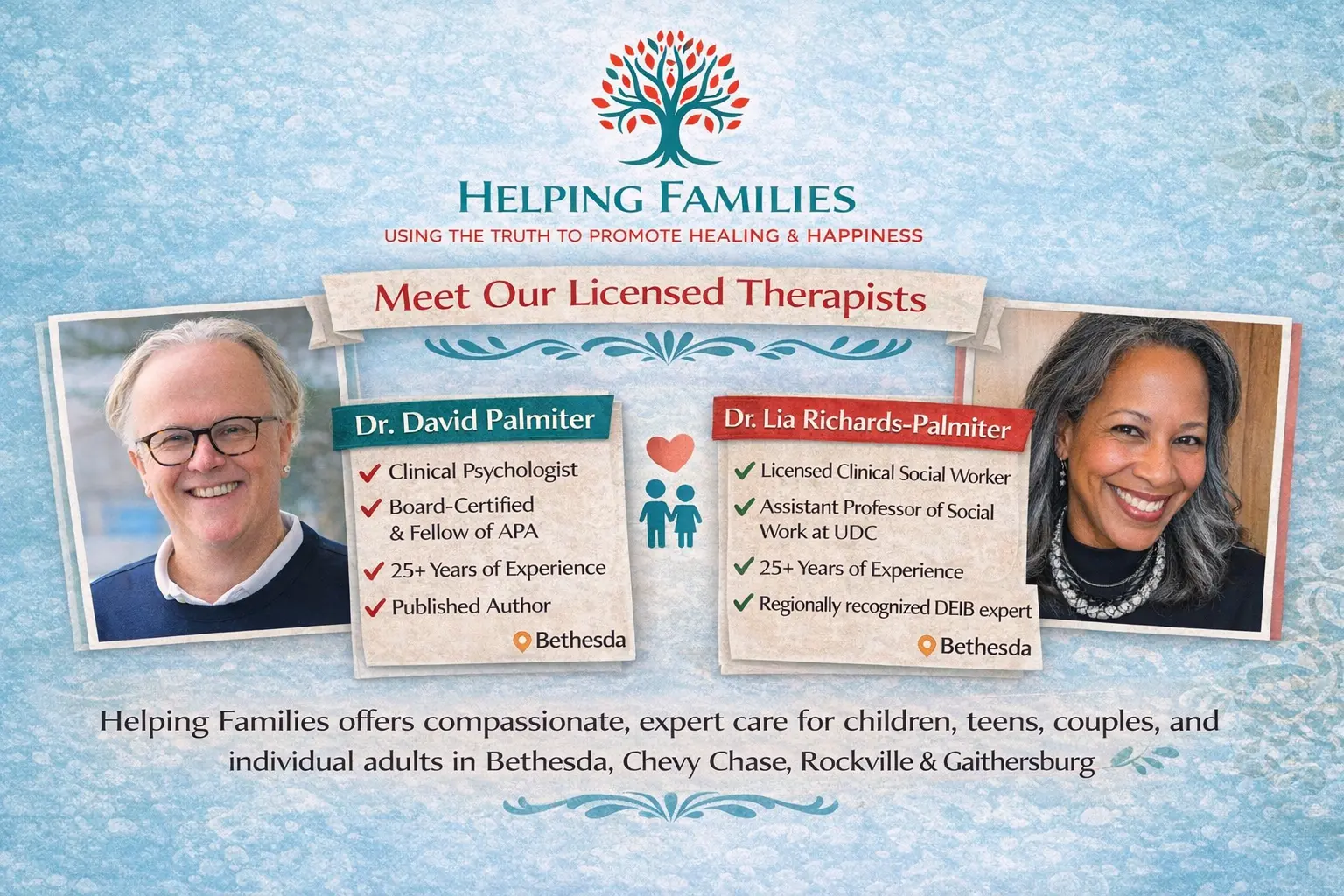
Helping Families is a psychotherapy practice dedicated to providing a safe and caring space for individuals, children, adolescents, families and couples to explore, heal and self-actualize. Our practice is built on over 50 years of experience offering specialized and science-based mental health care tailored to the unique needs of each person and family. We are committed to helping families and individuals break free from emotional distress and lead enriching lives. Our approach is rooted in empathy, understanding, DEIB awareness, and evidence-based techniques to support transformative change.
ADHD is a highly misunderstood neurodiversity. Our approach is to use evidence-based methods for diagnosing, treating and actualizing the unique potential of every person who either has ADHD or who lives with a loved one with ADHD.
Anxiety can be overwhelming, but a science-based treatment can often keep it from interfering with the quality of a person’s life. Our therapy sessions provide a safe environment for individuals to explore the root causes of anxiety and to develop coping strategies for living a calmer, more balanced life.
Depression can feel crushing and isolating, but you or your child can often find significant relief. Our science-based and tailored approach to treating mood disorders offers people a collection of practical tools to regain hope, find purpose, and develop the skills to navigate through life's challenges with resilience.
Nothing gets a kid referred faster for mental health care than annoying an adult. Oppositional Defiant Disorder and Conduct Disorder can dramatically unsettle a classroom and a home life, making it a top stress for all involved. We use science-based treatments to eliminate ODD, in a child 12 years or younger, in the large majority of instances, in 8 or less sessions. The transformation can be so quick and dramatic that many parents have asked us things like, "why isn't this information taught on maternity units in hospitals?!"
Experiences of isms–racism, sexism, ageism, religionism, heterosexism and others–are ubiquitous in our culture, as are more subtle micro aggressions and systemic bias towards power down groups. In our practice we keep these issues in focus when a client has been hurt by them and help each person to grow in their advocacy skills while making tactical decisions about how they wish to proceed.
Just about all of our clients present with a primary and acute concern (e.g., ADHD, mood, anxiety). However, our clients have greater ambitions than only to stop feeling badly. They want more and deeper experiences of meaning and joy. This is where the science of positive psychology comes into play. We routinely weave these interventions, of which we are very familiar, into the evidence-based structures that we offer.
Childhood and adolescence can be a challenging time. Our therapies for kids and teens provide a supportive space to navigate complex emotions, build self-esteem, manage challenging family and school dynamics, and develop healthy coping mechanisms for a brighter future, both individually and within the family.
Couples therapy provides a safe space for partners to explore challenges, enhance communication, and rebuild trust. Our goal is to help couples deepen their understanding of each other and create a more fulfilling and harmonious relationship that is well equipped to solve problems and to have difficult conversations.
One of our favorite things to do is to work with adults who are sick-and-tired of being sick-and-tired. As Thoreau put it, many adults lead “…lives of silent and go to the grave with the song still in them.” We have a long track record of helping adults to use their top strengths, and the evidence-based skills we teach, to access the lavish banquet that surrounds us all and to live lives lavish with meaning and rich with purpose.
Psychotherapy is a place to deeply reflect on how life is going. We are all so busy and overscheduled that creating this kind of space can be transformative. We are expert at using the truth of our clients’ lives to create understanding, to alleviate suffering, and to expand on experiences of meaning and joy.
Talk with a trusted therapist and take the next step forward with confidence.
We work with kids, teens and adults, starting at age 4.
We have the most experience with ADHD, Oppositional Defiant Disorder, Generalized Anxiety Disorder, Post-Traumatic Stress Disorder, OCD, Depression, Autism and helping kids overcome experiences of bullying, racism and microaggressions. However, we also have experience treating less common conditions such as Juvenile Onset Bipolar Disorder and Reactive Attachment Disorder.
This is a strength of our practice. When he was President of the Pennsylvania Psychological Association, Dr. Dave co-chaired a collaboration between the state’s child psychologists and pediatricians. The principal goal of this work was to develop a standard of care for outpatient mental health evaluations of youth. We use this protocol in our practice. It includes the following elements:
• A 90-minute interview with the child/teen of concern and their parents (in instances when there are two households, we collaborate on which adults to include).
• A 50-minute interview with the child/teen. For kids this often includes observations of drawing and play.
• The completion of a battery of parent, teacher and child/teen rating scales.
• Review of academic records
• Review of relevant clinical or forensic records
• The creation of a slide show that includes the following elements: sources of information, strengths, charts of behavior rating scales, a list of problems, a diagnostic impression and a list of interventions for the identified problems.
In preparing for the feedback we typically invest 3-4 hours of our time.
There are three ways we’d like to address this question.
First, we find that our field is replete with clinicians who are less aligned with the available science than our practice; this is also a finding in psychotherapy outcome studies. For this comparison the contrast is stark. We do a thorough evaluation, explain our goals and methods at each juncture, set measurable treatment goals, and empower our clients to verify for themselves how the science supports what we have concluded and what we are recommending.
Most of the treatments we offer are also structured, focused on skill building and involve between session practice (exceptions are when clients could benefit from psychodynamic therapy or play therapy, which we also offer). While a non-science-based practice can feel nice it may not yield transformational change (sort of like a psychological massage) and may be harder to differentiate from what an intelligent, life-experienced and warm-hearted friend might offer at no cost.
Second, another evidence-based practice will look more similar than different to ours.
However, a few things we offer that are less common is the thoroughness of the initial evaluation, our focus on strengths, our inclusion of biofeedback to treat anxiety, anger and stress management, the use of magic to engage kids and teens, our common practice of going into schools to collaborate on helping our child/teen clients, and an acute focus on how to effectively identify and manage experiences of isms and micro aggressions when that is relevant to the care.
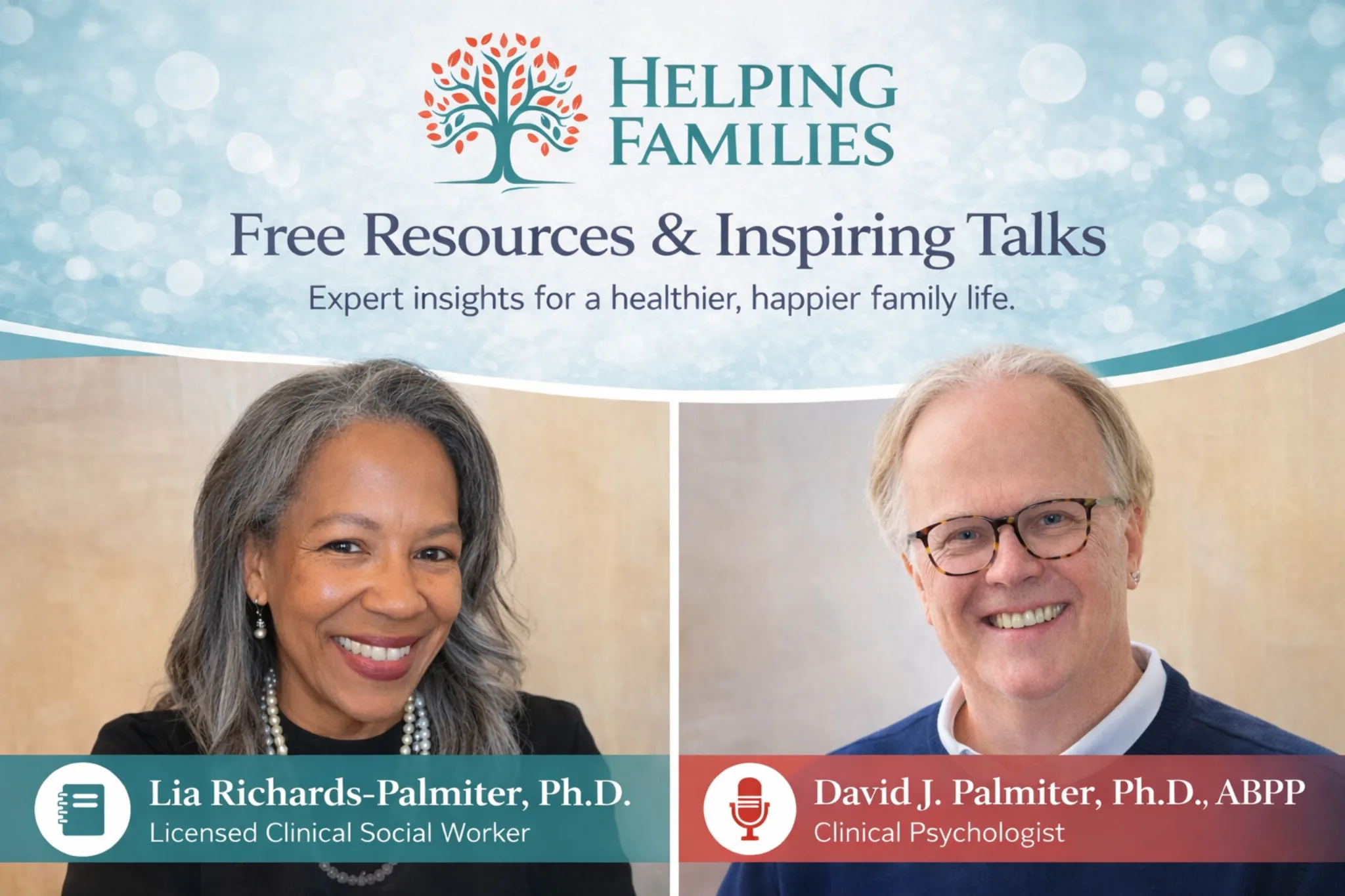
Third, we are highly experienced and credentialed clinicians, published authors, media consultants and leaders in our fields. Bios ( Dr. Dave's BIO ) - ( Dr. Lia's BIO )
Our approach can best be described as a blending of behavioral (e.g., Gottman Institute) and emotionally focused (e.g., EFT) methods. (Dr. Dave can be found on the Gottman Institute’s therapist directory which only includes those clinicians that have completed at least two levels of their training).
Our initial evaluation includes a 90-minute couple interview, the completion of the Gottman Institute’s battery for couples (at no additional charge), the completion of a battery supplemental measures, a 50-minute feedback session and the preparation of a slide show that includes sources of information, strengths, results of the rating scales, a list of problems and a list of recommended interventions. It is common for us to spend 3-4 hours preparing for the feedback session.
Our treatment approach involves skill building, is structured and usually time limited. We say “usually” as the work can take longer when there are significant resentments that need to be resolved. In our opinion, the skills we teach are ones that all couples would do well to know before formalizing a long-term commitment. They are also practices that promote resilience in a couple’s life.
Yes, we do. The evaluation consists of a 90-minute interview, the use of behavior rating scales, a review of relevant records, and a feedback session that incorporates a slideshow that includes sources of information, strengths, results of rating scales, a problem list, a diagnostic formulation and a list of recommended interventions. We usually spend about two hours preparing the feedback for a standard adult evaluation.
We also specialize in ADHD adult evaluations; these include the additional elements of collaterals filling out rating scales, a review of academic records and any other records that might be helpful (e.g., performance evaluations at work). (Dr. Dave is formerly the Clinical Director of a nationally recognized ADHD specialty clinic and currently serves on the national Board of Directors for CHADD.)
The areas in which we have the most experience are ADHD, anxiety disorders (including OCD and PTSD), mood disorders, self-esteem, self-compassion, existential crises and self-actualization. We also focus on identifying and overcoming the effects of isms and micro aggressions when that is relevant. (Dr. Lia is on the faculty of an HBCU and has offered countless training on DEI issues for schools, employers, corporations and non-profits)
There are four things we’d like to say in response to this question.
First, our services are based on $280/hour, which we find is a little bit under what clinicians at our level of experience and credentials tend to charge in the DMV.
Second, while we are out-of-network providers, we arrange for our clients–at no cost–to use the services of Reimbursify.com to submit our statements to health insurance companies for reimbursement.
Third, please consider our bios and/or CVs ( Dr. Dave's BIO ) - ( Dr. Lia's BIO ). It’s difficult to summarize them here as we have 50+ years of cumulative experiencing doing clinical work, serving as professors, holding leadership positions, publishing (i.e., books, chapters and articles) and being media consultants.
Fourth, when thinking about costs, consider the costs that can be associated with not getting needed mental health treatment. For example, the cost of a contested divorce in the DMV ranges between $15,000 and $30,000+ per person, suicide is the second leading cause of death among people aged 10-24, unresolved mental health challenges increase the odds of substance dependence, academic underachievement, school dropout, vocational underdevelopment, relationship dissatisfaction, compromised physical health and overall lower quality of life. Also, consider what it would be like to be free of that which is troubling you, your child or your partner the most.
Compassionate, evidence-based therapy for children, teens, and couples—supporting healing from trauma, anxiety, depression, and ADHD while building resilience, connection, and lasting change.