Arguing is not a significant problem when relationships are solid. Every couple disagrees. Every couple has moments of disappointment, irritation, defensiveness, and hurt feelings. The deeper issue is usually how the conflict is handled. That is where communication can either protect the relationship or tax it. When couples speak in ways that escalate tension, reduce safety, and increase blame, even small disagreements can grow into bigger emotional injuries. When couples learn better communication during conflict with their partner, the same disagreement can become more manageable, more honest, and far less destructive.
Many people assume that good communication during conflict means staying perfectly calm, saying exactly the right words, or never getting dysregulated. That is not realistic. Conflict often touches the most sensitive parts of a relationship. It can activate fear, frustration, loneliness, resentment, or the sense that you are not being understood by your life partner. In those moments, people naturally become reactive. The goal is not to become robotic. The goal is to communicate in a way that gives the relationship a chance.
For couples in Bethesda, MD looking for a psychotherapy practice, this topic often feels especially important because the pressure of daily life can make relationship conflict more intense. Work stress, parenting demands, financial concerns, family obligations, and emotional overload can all shorten patience and make couples more likely to speak from hurt rather than clarity. At Helping Families, many couples are not looking for a perfect marriage. They are looking for practical ways to stop the same painful patterns from repeating. They want to feel heard without having to fight so hard for it. They want to raise concerns without immediately triggering defensiveness. They want to disagree without feeling like the entire relationship is under threat.
The good news is that better communication during conflict is a skill. It can be learned, practiced, and strengthened over time. Even couples who feel stuck can begin changing the tone and direction of their disagreements when they understand what tends to go wrong and what to do differently.
Why Conflict Communication Breaks Down So Fast
When conflict starts, most people do not respond with their most thoughtful self. They respond with their sympathetic nervous system (SNS), which is what is triggered when we feel threatened or are overwhelmed. The SNS reacts quickly. The mind narrows. Attention shifts from understanding to protecting. Instead of listening for what the other person means, each partner starts building a case. One person is trying to prove they are right. The other is trying to defend themselves from blame. The result is that the conversation becomes less about resolution and more about survival.
This is why communication during conflict with your partner often feels so hard, even for people who care deeply about each other. A partner’s criticism can feel like rejection. Withdrawal can feel like abandonment. Stonewalling can feel like indifference. One harsh sentence can bring up numerous concerns.
Once that happens, many couples fall into familiar patterns. They interrupt. They repeat themselves louder. They argue about tone instead of the issue. They start listing old grievances. They interpret each other’s words in the worst possible way. Even if the original problem was small, the conversation quickly becomes about respect, care, fairness, and whether the relationship feels emotionally safe.
Understanding this matters because it helps couples stop seeing bad conflict as evidence that they are fundamentally wrong for each other. Often, it means they need better tools and more awareness. The problem is not always the topic itself. Often, it is the way the topic is being approached.
Better Conflict Communication Starts Before the First Sentence
Most couples focus on what they say during conflict, but what happens inside before speaking matters just as much. If you go into a disagreement already convinced that your partner is selfish, impossible, or uninterested in understanding you, your tone and word choice will reflect that belief. If you go into the same conversation believing that your partner is a flawed but basically decent person who may be stressed, hurt, or reactive, the conversation will often sound very different.
This is one of the most important shifts in communication during conflict with your partner: move from accusation to curiosity. Curiosity does not mean you avoid your point. It means you do not treat your interpretation as the only possible truth before the conversation even begins. That shift creates room for questions like, “What happened for you there?” “What did you hear me say?” “What are we both reacting to right now?” Those questions keep the relationship open. Accusations tend to promote defensiveness and retaliation.
Many couples underestimate how much emotional tone is shaped by mindset. If you begin a hard conversation as though you are approaching an enemy, your partner will often feel that and respond in kind. If you begin as though you are approaching someone you love, even while feeling frustrated, the conversation has a better chance of staying connected.
The Problem with Leading with Your Strongest Argument
When people are upset, they usually want to start with the most convincing part of their position. They lead with the evidence that supports their own frustration. They explain what the other person did wrong, why it was unfair, and why their own reaction makes sense. From a logical standpoint, that feels reasonable. From a relationship standpoint, it often fails to resolve concerns.
The reason is simple. When one person leads with criticism, the other usually becomes defensive before any real listening can happen. Once defensiveness takes over, it becomes difficult for either partner to hear the more vulnerable truth underneath the complaint. That truth may be something like, “I feel alone,” “I miss you so much,” “I am hoping for your kindness,” or “I was hurt that this mattered to me and it did not seem to matter to you.” But those softer truths often get buried beneath sharp language and stronger accusations.
Healthier communication during conflict with your partner often feels unnatural at first because it asks you to describe your concerns with more vulnerability. Instead of beginning with the case against your partner, you begin with the part of the situation that invites understanding. Try starting with two kinds of content: (1) your recognition of your partner’s good intentions and effort regarding the topic under review and (2) mistakes you acknowledge you’ve made, without self-justification, regarding the problem. Then let your partner respond. Then you would go with a more vulnerable approach for articulating your wishes and needs.
For example, “You never listen until I get upset” will usually produce a different response than “I appreciate that you’ve been working hard on this issue (with examples) and that your intentions are golden (with elaboration).” Letting your partner respond, and then going with things like, “I’ve just been missing you with all of the rushing about that we’re doing these days.”
Say What You Feel and Need Before You Build the Case
One of the most effective ways to improve conflict communication is to speak from your direct experience before launching into your full argument. Couples often reverse that order. They explain what happened, why it was wrong, how often it happens, what it reminds them of, and why their partner should already know better. Only much later, if ever, do they reveal the more human feeling underneath; they also often miss discussing the good in their partner regarding the problem as well as their mistakes.
That sequence makes conflict harder than it needs to be. This kind of honesty is not weakness. It is clarity. It helps your partner understand what the moment meant to you instead of only hearing how they failed. In many relationships, a conversation becomes more productive the moment one person stops trying to win the point and starts revealing the dream for the relationship that is feeling taxed. As is sometimes said, “you can be right or you can be happily married.”
That may sound like:
- “I felt embarrassed when our children saw us arguing so heatedly.”
- “I was feeling weak and was hoping to lean on your strength.”
- “I was feeling lonely and was hoping reconnecting with you might help.”
- “This may sound small, but it touched something bigger for me from my childhood.”
Statements like these do not guarantee agreement, but they usually lower the chance that the conversation will become a courtroom.
Listen for the Meaning, Not Just the Words
Good communication during conflict with your partner requires more than waiting for your turn to speak. It requires listening for the feeling, fear, need, or dream underneath the words being said. That is especially important when your partner is not expressing themselves eloquently, which is often the case in conflict.
Many people hear a complaint and immediately respond to the surface language. Their partner says, “You never help!” and they reply, “That is not true, I helped yesterday!” Technically, they may be right. Emotionally, they may be missing the point. The deeper meaning may be, “I’m feeling incompetent—and worry about how that will affect our kids—while you seem so strong in this area.” If that deeper meaning is ignored, the couple stays stuck arguing about the literal accuracy of a complaint instead of addressing the emotional reality behind it.
This does not mean you should accept unfair statements without question. Empathy ≠ agreement. It means you should try to hear what is being expressed beneath the exaggeration, frustration, or imperfect wording and respond with empathy. When you do that, the conflict often softens because your partner feels understood at a more meaningful level.
You can show that kind of listening with responses like, “It sounds like you have been feeling alone in this,” or “I hear that this affected you more deeply than I realized,” or “You seem hurt, not just annoyed.” That kind of response does not solve everything, but it makes resolution far more possible than simply counterattacking the phrasing.
Slow the Pace Before the Conversation Starts Running You
One of the hardest parts of relationship conflict is how quickly the SNS activates. Voices rise. Sentences get shorter and harsher. Partners interrupt each other. The conversation becomes flooded with intensity, and once that happens, clear thinking is compromised (e.g., the prefrontal cortex, or the CEO of us, takes a nap when the SNS is active and we all lose IQ points). In many cases, what couples need most is not a better comeback but a slower and calmer pace.
Slowing down can be as simple as pausing before responding, lowering your voice instead of matching the other person’s intensity, or saying, “I want to answer that carefully,” instead of blurting out the first defensive thought that comes to mind. It may also mean taking a short break when the conversation is becoming unmanageable, if the break is used to regulate rather than avoid. If your heart beats per minute rises to triple digits, it may not be the best time to engage in a challenging communication; in these moments you might do well to calm down first. Consider this aphorism, “learn to zip it with high beats per minute.”
Pausing is not the same as stonewalling. Stonewalling leaves the other person abandoned in the conflict. A healthy pause sounds more like, “I want to keep talking, but I am too reactive right now to do it well. Can we take twenty minutes and come back?” That kind of pause protects the relationship because it shows commitment to the conversation without forcing it to continue when one or both of you are biologically primed for combat or escape.
Do Not Mix the Present Issue with Other Lamentations
Many conflicts become overwhelming because couples pile too much into them. A disagreement about dinner plans becomes a fight that includes lamentations that predate the Old Testament, who carries the mental load, who is appreciated less, what happened on a vacation two years ago, and whether one partner’s family has always been intrusive. Once a conversation gets overloaded like that, resolution becomes much harder.
Healthy communication during conflict with your partner means staying anchored to the issue at hand long enough to address it meaningfully. That can feel difficult when the current issue touches older pain, but it is still important. If everything comes in at once, both people are more likely to feel flooded and defeated.
That does not mean older patterns should never be discussed. It means they should be discussed intentionally, not used as emotional reinforcements in the middle of a heated argument. Saying, “This moment is bringing up a larger pattern we may need to talk about separately,” is very different from unloading the entire relationship history like a double-barreled shotgun blast.
Repair Matters More Than Perfection
Even couples with strong skills will still get it wrong sometimes. They will speak too sharply, misread each other, become defensive, or react from hurt. The goal is not flawless conflict. The goal is repair. Repair is what helps a relationship recover after tension instead of staying damaged by it.
Repair may sound like, “I may not agree with everything you said, but I can see that you were hurting.” It may be, “I got defensive, and I want to try again with a more open heart and mind.” It may be, “That came out way harsher than I intended. I love you very much and appreciate that your dreams and intentions for me are golden.” These moments matter because they show that the relationship is more important than pride or winning the right-wrong game. Besides, the prize for winning the right-wrong game is usually an empty bag or, ultimately, a divorce.
One of the most healing shifts in communication during conflict with your partner is learning that conflict does not have to end with total agreement or close connection. Sometimes the real progress is that both people feel more understood, more respected, and less alone in the disagreement.
When Couples Therapy Can Help
Sometimes couples know what healthier communication looks like but struggle to do it consistently on their own. Or they lack effective and science-based procedures for these challenging communications. The same fights keep happening. One partner pursues harder while the other shuts down faster. Attempts to talk turn into defensiveness within minutes. Past hurts stay active in every new disagreement. In these situations, marriage counseling can be extremely helpful.
Couples therapy doesn’t involve the therapist acting like King Solomon and deciding a series of disputes. Instead, it gives the relationship a safe and structured place where both people can slow down, identify patterns, and practice new ways of communicating and solving problems based on research into what works and what doesn’t. It can help partners recognize how they trigger each other, communicate more clearly, and rebuild emotional safety. It can also help them understand that the conflict pattern itself is usually a shared problem, not just a one-person problem.
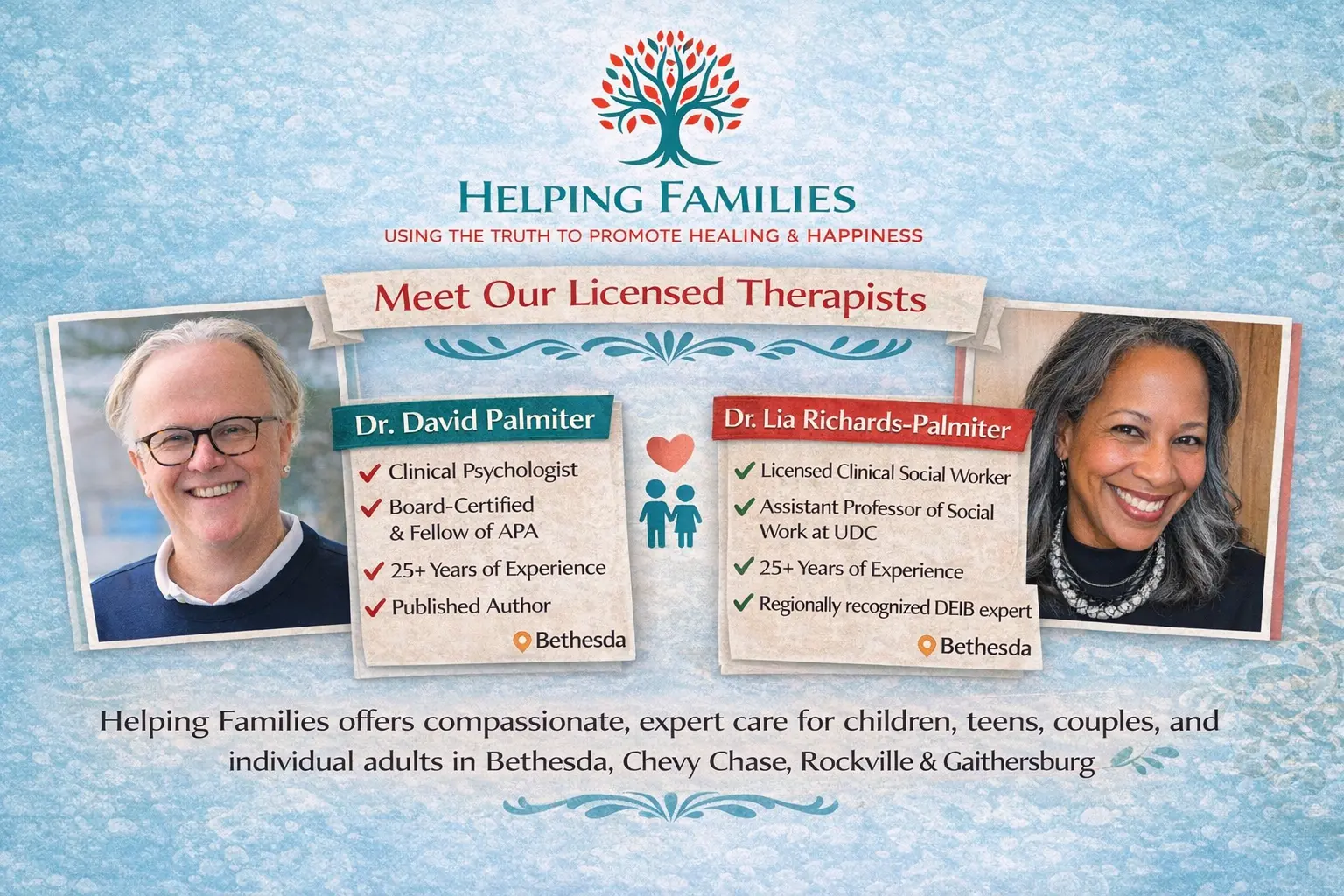
For couples living in Bethesda, Chevy Chase, Rockville or Gaithersburg, MD, working with a clinical psychologist or a psychiatric social worker at Helping Families can be a meaningful step toward changing the relationship dynamic before resentment grows deeper. Therapy is not only for couples on the edge of separation. It can also be a practical, proactive way to strengthen communication and promote a thriving partnership.
Final Thoughts
Better communication during conflict with your partner does not mean learning how to avoid every disagreement. It means learning how to disagree without turning every hard conversation into a threat to the relationship. It means pointing out the good in your partner, graciously owning mistakes, speaking from vulnerability sooner, listening beneath the surface, slowing the pace, resisting the urge to attack, and making repair part of the process.
Conflict will always reveal something important about a relationship. It shows where partners feel hurt, unseen, overloaded, disappointed, or disconnected. When communication is poor, those truths come out in ways that make resolution harder. When communication improves, the same truths can become a path toward greater understanding.
If your relationship has fallen into repetitive arguments, defensiveness, or emotional distance during conflict, support can help. At Helping Families in Bethesda, MD, couples can find a safe and caring space to explore relationship challenges, improve communication, and build healthier ways of responding to tension. Stronger communication is not about saying everything perfectly. It is about learning how to have difficult conversations and solve problems when your first instinct is to rip your partner’s face off or to look for employment opportunities in Alaska.