To Use the Truth to Promote Healing and
Happiness

The Purpose of Psychotherapy

Our Approach

Helping Families is a psychotherapy practice dedicated to providing a safe and caring space for individuals, children, adolescents, families and couples to explore, heal and self-actualize. Our practice is built on over 50 years of experience offering specialized and science-based mental health care tailored to the unique needs of each person and family. We are committed to helping families and individuals break free from emotional distress and lead enriching lives. Our approach is rooted in empathy, understanding, DEIB awareness, and evidence-based techniques to support transformative change.

ADHD

ADHD is a highly misunderstood neurodiversity. Our approach is to use evidence-based methods for diagnosing, treating and actualizing the unique potential of every person who either has ADHD or who lives with a loved one with ADHD.

Anxiety

Anxiety can be overwhelming, but a science-based treatment can often keep it from interfering with the quality of a person’s life. Our therapy sessions provide a safe environment for individuals to explore the root causes of anxiety and to develop coping strategies for living a calmer, more balanced life.

Depression

Depression can feel crushing and isolating, but you or your child can often find significant relief. Our science-based and tailored approach to treating mood disorders offers people a collection of practical tools to regain hope, find purpose, and develop the skills to navigate through life's challenges with resilience.

Disruptive Behavior

Nothing gets a kid referred faster for mental health care than annoying an adult. Oppositional Defiant Disorder and Conduct Disorder can dramatically unsettle a classroom and a home life, making it a top stress for all involved. We use science-based treatments to eliminate ODD, in a child 12 years or younger, in the large majority of instances, in 8 or less sessions. The transformation can be so quick and dramatic that many parents have asked us things like, "why isn't this information taught on maternity units in hospitals?!"

DEIB

Experiences of isms–racism, sexism, ageism, religionism, heterosexism and others–are ubiquitous in our culture, as are more subtle micro aggressions and systemic bias towards power down groups. In our practice we keep these issues in focus when a client has been hurt by them and help each person to grow in their advocacy skills while making tactical decisions about how they wish to proceed.

Happiness

Just about all of our clients present with a primary and acute concern (e.g., ADHD, mood, anxiety). However, our clients have greater ambitions than only to stop feeling badly. They want more and deeper experiences of meaning and joy. This is where the science of positive psychology comes into play. We routinely weave these interventions, of which we are very familiar, into the evidence-based structures that we offer.

Therapy for Youth

Childhood and adolescence can be a challenging time. Our therapies for kids and teens provide a supportive space to navigate complex emotions, build self-esteem, manage challenging family and school dynamics, and develop healthy coping mechanisms for a brighter future, both individually and within the family.

Couples Therapy

Couples therapy provides a safe space for partners to explore challenges, enhance communication, and rebuild trust. Our goal is to help couples deepen their understanding of each other and create a more fulfilling and harmonious relationship that is well equipped to solve problems and to have difficult conversations.

Adult Therapy

One of our favorite things to do is to work with adults who are sick-and-tired of being sick-and-tired. As Thoreau put it, many adults lead “…lives of silent and go to the grave with the song still in them.” We have a long track record of helping adults to use their top strengths, and the evidence-based skills we teach, to access the lavish banquet that surrounds us all and to live lives lavish with meaning and rich with purpose.

A Path to Healing and Happiness Starts Here.

Psychotherapy is a place to deeply reflect on how life is going. We are all so busy and overscheduled that creating this kind of space can be transformative. We are expert at using the truth of our clients’ lives to create understanding, to alleviate suffering, and to expand on experiences of meaning and joy.

Book Your First Free Consultation

Talk with a trusted therapist and take the next step forward with confidence.

Got Questions? We Have Answers!

We work with kids, teens and adults, starting at age 4.

We have the most experience with ADHD, Oppositional Defiant Disorder, Generalized Anxiety Disorder, Post-Traumatic Stress Disorder, OCD, Depression, Autism and helping kids overcome experiences of bullying, racism and microaggressions. However, we also have experience treating less common conditions such as Juvenile Onset Bipolar Disorder and Reactive Attachment Disorder.

This is a strength of our practice. When he was President of the Pennsylvania Psychological Association, Dr. Dave co-chaired a collaboration between the state’s child psychologists and pediatricians. The principal goal of this work was to develop a standard of care for outpatient mental health evaluations of youth. We use this protocol in our practice. It includes the following elements:

• A 90-minute interview with the child/teen of concern and their parents (in instances when there are two households, we collaborate on which adults to include).

• A 50-minute interview with the child/teen. For kids this often includes observations of drawing and play.

• The completion of a battery of parent, teacher and child/teen rating scales.

• Review of academic records

• Review of relevant clinical or forensic records

• The creation of a slide show that includes the following elements: sources of information, strengths, charts of behavior rating scales, a list of problems, a diagnostic impression and a list of interventions for the identified problems.

In preparing for the feedback we typically invest 3-4 hours of our time.

There are three ways we’d like to address this question.

First, we find that our field is replete with clinicians who are less aligned with the available science than our practice; this is also a finding in psychotherapy outcome studies. For this comparison the contrast is stark. We do a thorough evaluation, explain our goals and methods at each juncture, set measurable treatment goals, and empower our clients to verify for themselves how the science supports what we have concluded and what we are recommending.

Most of the treatments we offer are also structured, focused on skill building and involve between session practice (exceptions are when clients could benefit from psychodynamic therapy or play therapy, which we also offer). While a non-science-based practice can feel nice it may not yield transformational change (sort of like a psychological massage) and may be harder to differentiate from what an intelligent, life-experienced and warm-hearted friend might offer at no cost.

Second, another evidence-based practice will look more similar than different to ours.
However, a few things we offer that are less common is the thoroughness of the initial evaluation, our focus on strengths, our inclusion of biofeedback to treat anxiety, anger and stress management, the use of magic to engage kids and teens, our common practice of going into schools to collaborate on helping our child/teen clients, and an acute focus on how to effectively identify and manage experiences of isms and micro aggressions when that is relevant to the care.

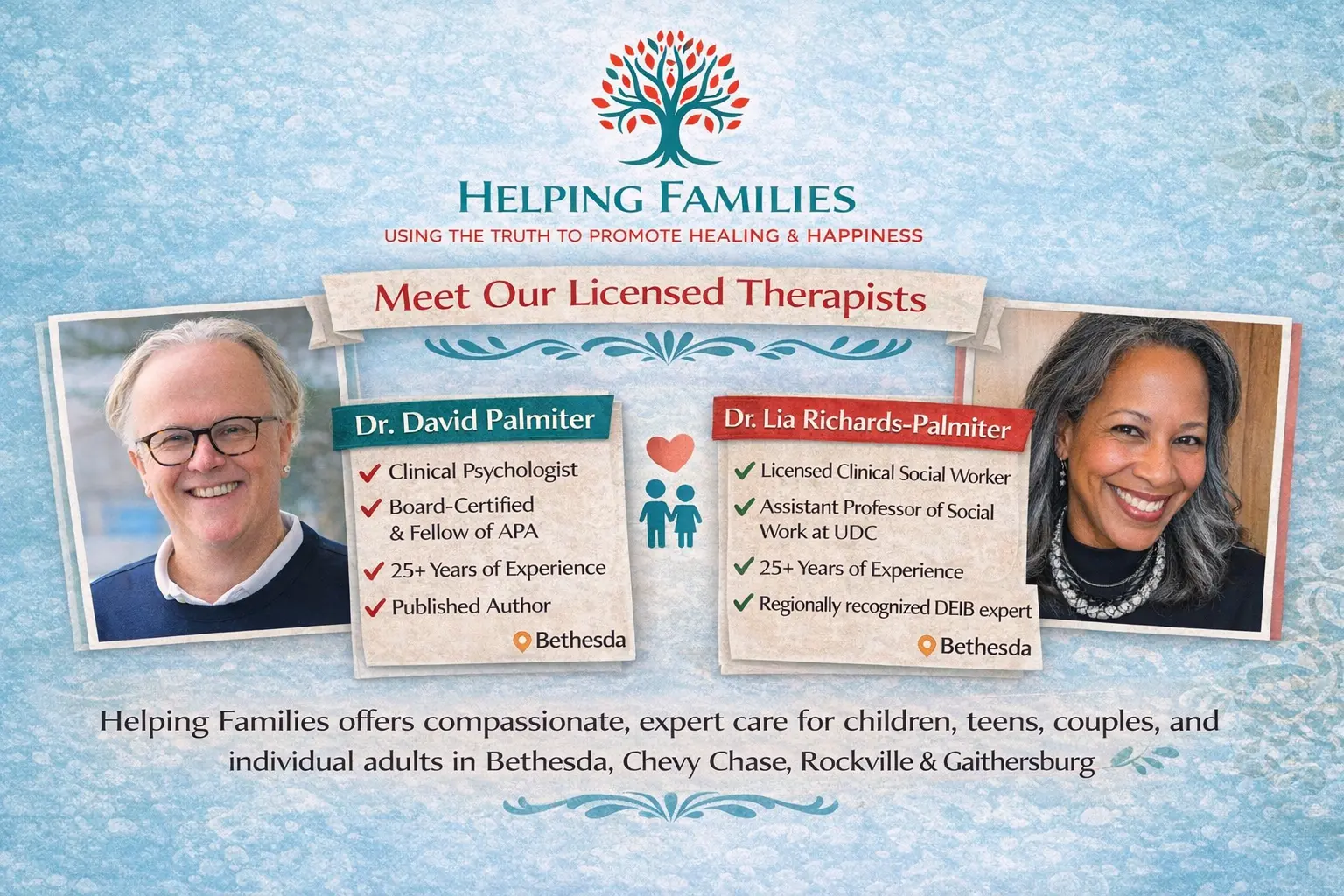
Third, we are highly experienced and credentialed clinicians, published authors, media consultants and leaders in our fields. Bios ( Dr. Dave's BIO ) - ( Dr. Lia's BIO )

Our approach can best be described as a blending of behavioral (e.g., Gottman Institute) and emotionally focused (e.g., EFT) methods. (Dr. Dave can be found on the Gottman Institute’s therapist directory which only includes those clinicians that have completed at least two levels of their training).

Our initial evaluation includes a 90-minute couple interview, the completion of the Gottman Institute’s battery for couples (at no additional charge), the completion of a battery supplemental measures, a 50-minute feedback session and the preparation of a slide show that includes sources of information, strengths, results of the rating scales, a list of problems and a list of recommended interventions. It is common for us to spend 3-4 hours preparing for the feedback session.

Our treatment approach involves skill building, is structured and usually time limited. We say “usually” as the work can take longer when there are significant resentments that need to be resolved. In our opinion, the skills we teach are ones that all couples would do well to know before formalizing a long-term commitment. They are also practices that promote resilience in a couple’s life.

Yes, we do. The evaluation consists of a 90-minute interview, the use of behavior rating scales, a review of relevant records, and a feedback session that incorporates a slideshow that includes sources of information, strengths, results of rating scales, a problem list, a diagnostic formulation and a list of recommended interventions. We usually spend about two hours preparing the feedback for a standard adult evaluation.

We also specialize in ADHD adult evaluations; these include the additional elements of collaterals filling out rating scales, a review of academic records and any other records that might be helpful (e.g., performance evaluations at work). (Dr. Dave is formerly the Clinical Director of a nationally recognized ADHD specialty clinic and currently serves on the national Board of Directors for CHADD.)

The areas in which we have the most experience are ADHD, anxiety disorders (including OCD and PTSD), mood disorders, self-esteem, self-compassion, existential crises and self-actualization. We also focus on identifying and overcoming the effects of isms and micro aggressions when that is relevant. (Dr. Lia is on the faculty of an HBCU and has offered countless training on DEI issues for schools, employers, corporations and non-profits)

There are four things we’d like to say in response to this question.

First, our services are based on $280/hour, which we find is a little bit under what clinicians at our level of experience and credentials tend to charge in the DMV.

Second, while we are out-of-network providers, we arrange for our clients–at no cost–to use the services of Reimbursify.com to submit our statements to health insurance companies for reimbursement.

Third, please consider our bios and/or CVs ( Dr. Dave's BIO ) - ( Dr. Lia's BIO ). It’s difficult to summarize them here as we have 50+ years of cumulative experiencing doing clinical work, serving as professors, holding leadership positions, publishing (i.e., books, chapters and articles) and being media consultants.

Fourth, when thinking about costs, consider the costs that can be associated with not getting needed mental health treatment. For example, the cost of a contested divorce in the DMV ranges between $15,000 and $30,000+ per person, suicide is the second leading cause of death among people aged 10-24, unresolved mental health challenges increase the odds of substance dependence, academic underachievement, school dropout, vocational underdevelopment, relationship dissatisfaction, compromised physical health and overall lower quality of life. Also, consider what it would be like to be free of that which is troubling you, your child or your partner the most.
Stronger Kids. Stronger Relationships.

Compassionate, evidence-based therapy for children, teens, and couples—supporting healing from trauma, anxiety, depression, and ADHD while building resilience, connection, and lasting change.

Helping Families

Compassionate, evidence-based psychotherapy for children, teens, individuals, and couples—supporting trauma recovery, anxiety, depression, ADHD, and healthier relationships.

Blog

Explore our blog for compassionate, evidence-based insights and practical guidance to support the emotional well-being and growth of individuals, children, couples, and families.