Every family member gets hurt sometimes. That does not mean something has gone terribly wrong. It means human beings are living closely together, carrying stress, histories, needs, disappointments, and strong emotions into the same shared space. Parents lose patience. Children say hurtful things. Siblings wound each other. Couples misunderstand one another. Someone forgets something important. Someone reacts too sharply. Someone shuts down when connection is needed most. Over time, these moments can pile up. That is why forgiveness in family life is not a peripheral agenda. It is one of the central ways a family stays emotionally healthy over the long run.
When forgiveness is missing, ordinary hurts are buried alive and can grow into something bigger. Family members start carrying old resentment into new conversations. A small disagreement begins to feel loaded because it is no longer just about the moment at hand. It is about the apology that never came, the harsh words that still sting, the years of feeling unseen, or the pattern that never seemed to change. Tension can then become the background noise of family life.
When forgiveness is present, something different becomes possible. People are still imperfect. They still make mistakes. They still disappoint one another. But the family develops a way to heal after harm. There is more room for repair, more room for empathy, and more room for people to grow without being permanently trapped inside their worst moment. Forgiveness does not erase or justify pain or make relationships healthy. What it does is create a path forward when one family member has hurt another.
For families in Bethesda, Chevy Chase, Rockville and Gaithersburg, MD looking for a psychotherapy practice, this topic matters because many relationship struggles are not only about conflict. They are about what happens after conflict. Does the family know how to repair? Can people talk honestly about hurt without becoming defensive or emotionally frozen? Can the home become a place where healing happens, not just a place where wounds accumulate? At Helping Families, these questions are deeply important because healthy family life depends not only on love, but also on the ability to recover after injury.
This article explores why forgiveness in family life matters so much, what forgiveness really is, what it is not, and how families can begin practicing it in ways that lead to stronger relationships and a healthier emotional home.
Why Family Life Makes Forgiveness So Necessary
It is easy to think about forgiveness as something needed only after a major betrayal or a dramatic event. However, family life calls for forgiveness much more often than that. The need arises in ordinary daily moments. It appears when a parent snaps after a long day. It appears when a teenager says something cutting and later regrets it. It appears when one spouse feels unsupported and begins interpreting everything through the resulting pain. It appears when siblings compete, mock, exclude, or hit tender emotional spots they know too well.
The closer people are, the more influence they have over each other emotionally. Family members usually know where the sensitive places are. They know what matters, what hurts, what embarrasses, what frightens, and what has been difficult before. That closeness can create deep comfort, but it also means the wounds that happen inside families often go deeper than wounds from strangers. A thoughtless comment from someone outside the home may sting. The same comment from a spouse, child, parent, or sibling can stay with someone for a long time.
This is exactly why forgiveness in family life matters so much. Without it, hurts do not simply disappear on their own. They collect. They change the emotional tone of the home. They make family members quicker to react, slower to trust, and more likely to assume bad intent. The absence of forgiveness does not keep anyone safer. Usually, it keeps everyone more defended.
What Forgiveness Is and What It Is Not
Many people resist the idea of forgiveness because they misunderstand what it asks of them. They imagine that forgiving means pretending nothing happened, minimizing the pain, excusing behavior that truly caused harm or allowing ongoing injury. That is not what healthy forgiveness means.
Forgiveness is not forgetting. A person can remember clearly what happened and still choose not to let the injury control the future of the relationship. Forgiveness is not denial. It does not require pretending that hurt was not real. In fact, forgiveness usually begins by acknowledging that the wound matters. If the pain is not addressed authentically, the process can become shallow and performative rather than healing.
Forgiveness can occur both with trust being repaired and with trust not being repaired. Trust and forgiveness are related, but they are different. In some family situations, trust can be rebuilt relatively quickly. In others, it takes time, accountability, changed behavior, and repeated evidence that the relationship is becoming safer. A person can begin moving toward forgiveness while still needing boundaries, caution, and a clearer sense of what must change.
Most importantly, forgiveness is not permission for ongoing mistreatment. In healthy family life, forgiveness should never be used to pressure someone into staying quiet about harmful patterns. Real forgiveness does not erase accountability. It works best alongside accountability. It makes it possible to release bitterness without abandoning truth.
What Happens When Families Hold on to Hurt Too Long
When a family does not know how to forgive, hurt tends to become part of the structure of daily life. A parent may continue reacting to a child through the lens of a past disappointment. A spouse may bring old grievances into new disagreements. A child may carry shame after making a mistake and begin believing that one bad choice defines who they are. Siblings may repeat old roles year after year because no one has truly moved beyond earlier injuries.
In families like this, the emotional atmosphere changes. People become guarded. They may still care deeply about one another, but there is less softness in the home. There is less generosity in interpretation. More interactions feel loaded. More conversations feel risky. Family members start protecting themselves before they start understanding one another.
The difficult thing about resentment is that it often feels justified. When someone has been hurt, holding on to anger can feel like a way of honoring the wound or staying safe from being hurt again. But over time, resentment can also narrow a relationship until the injury becomes the main story. That is one reason forgiveness in family life is so important. It helps a family move from emotional paralysis back into movement, repair, and the possibility of connection.
Forgiveness Helps Families Repair Rather than Repeat
Every family has patterns. Some patterns are nurturing and resilient. Others are painful and repetitive. When forgiveness is absent, harmful patterns tend to repeat because no one truly gets unstuck. One person stays angry. Another stays defensive. A third learns to avoid conflict altogether. The original injury may fade from daily conversation, but the emotional consequences remain active.
Forgiveness interrupts that repetition. It gives family members a chance to repair the meaning of what happened instead of being trapped inside it. A child who is forgiven after a poor decision can learn responsibility without learning that they are permanently bad. A parent who apologizes and is forgiven can model humility and repair instead of authority without accountability. A couple who works through hurt can strengthen the marriage not by avoiding conflict, but by proving that the relationship can survive honest repair.
This is one of the healthiest truths about forgiveness in family life: it does not make families perfect. It makes them more flexible, more resilient, and more capable of recovering from the inevitable injuries that happen when real people live together.
Helping Children to Experience Forgiveness at Home
Children learn what relationships are supposed to feel like by living inside them. They learn from tone, from repetition, from the way conflict unfolds, and from what happens after someone makes a mistake. If a child grows up in a home where every error becomes a lasting mark against them, they may become anxious, defensive, secretive, or overly self-critical. They may begin to believe that love is fragile and that one misstep can permanently damage their place in the family.
On the other hand, when children experience forgiveness, they learn something essential: relationships can bend without breaking. They learn that accountability and love can exist together. They learn that people can do harm, admit it, repair it, and maintain their connection. That lesson matters not only for childhood, but for every future friendship, marriage, parenting role, and family bond they will later form.
This does not mean children should be shielded from consequences. Forgiveness doesn’t equate with releasing the forgiven person from their responsibility. A child may still lose a privilege, make amends, or need to rebuild trust after a harmful behavior. But when forgiveness is present, the consequence does not carry the message that the child is beyond grace. Instead, it communicates that the child is responsible for their actions and still deeply valued.
Forgiveness also Matters Between Adults in the Family
When people think about family life, they often focus on parenting. But forgiveness in family life also matters deeply between partners, co-parents, adult siblings, and extended family members. In fact, children are shaped by how the adults around them repair with one another.
A marriage or long-term partnership cannot stay emotionally healthy if every disappointment becomes permanent evidence in an internal case against the other person. Parenthood, work stress, money concerns, health issues, and the everyday exhaustion of adulthood all create moments where people will fall short of one another. That is not a sign of relational failure. It is a sign that the relationship needs repair processes, not just high expectations.
In strong adult relationships, forgiveness helps people stay connected without pretending they were never hurt. It allows a spouse to say, “That mattered, and I do not want to carry it forever.” It allows co-parents to move beyond old irritation so they can function as a healthier team. It helps siblings outgrow childhood patterns that no longer fit who they are trying to become as adults. It helps families stop living as though every old injury is still happening now.
What Healthy Forgiveness Usually Requires
Forgiveness is sometimes thought of as a single moment, but in family life it is usually more of a process. For many people, that process includes several important elements:
- Honest acknowledgment of what happened and why it hurt
- Space for the injured person to feel the impact instead of rushing past it
- Empathy for the human struggle behind the behavior, without excusing it
- A willingness to forgive the person who caused the pain and to release resentment
- When possible, changed behavior and accountability inside the relationship can strengthen the repair
Not every family member moves through these steps at the same pace. Some people forgive quickly but shallowly. Others take longer because the wound touched something deeper. Neither approach automatically means a person is doing it wrong. What matters is whether the process is moving toward truth, accountability, and emotional release rather than toward denial or endless retaliation.
In many families, one of the biggest challenges to forgiveness is rushing. Someone says “sorry,” and everyone is expected to move on immediately. That may restore surface peace, but it often does not create real healing. Lasting forgiveness in family life usually requires the steps listed above. It needs people to slow down long enough to understand what happened and why it mattered.
Why Some Families Get Stuck
If forgiveness is so important, why is it so hard? Often, families get stuck because forgiveness asks for two things that are both difficult: emotional vulnerability and a decision to forgive. Some people resist an authentic review of what happened because they fear conflict, shame, or vulnerability. Others resist forgiveness because holding on to anger feels protective. In both cases, the family can remain trapped between unresolved hurt and unresolved fear.
Families also get stuck when harmful patterns continue without change. It is much harder to move toward forgiveness when the same injury keeps happening again. In those situations, the work is not only about letting go. It is also about creating a safer relational pattern. Sometimes that means clearer boundaries. Sometimes it means family therapy. Sometimes it means helping one or more family members build skills around emotion regulation, communication, or accountability.
Another common obstacle is pride. In some families, apology feels humiliating or weak. People defend themselves rather than reflect. They explain instead of taking responsibility. They want forgiveness without truly facing the impact of what they did. That posture usually blocks repair. Healthy forgiveness grows much better in families where humility is practiced by adults as well as children.
How Families Can Begin Building a Forgiveness Practice
Forgiveness becomes more natural when it is part of the culture of the home, not only something reached for during major crises. A family can build this culture in ordinary ways. Parents can model apology without overdramatizing it. Children can be taught that mistakes matter, and repair matters too. Couples can choose to address resentment before it calcifies. Siblings can be guided not only toward “say sorry,” but toward understanding impact and restoring connection.
It also helps when family members learn to talk about hurt in ways that invite understanding rather than immediate defensiveness. Instead of storing up months of resentment, they learn to say, “That really affected me,” “I felt hurt when that happened,” or “I want us to repair this instead of letting it sit between us.” Those conversations are not always easy, but they help prevent injuries from becoming silent, permanent structures inside the family.
Families do not need to be endlessly emotional to do this well. They simply need to become more capable of repair. Often, the healthiest homes are not the ones with the least conflict. They are the ones where conflict does not harden into lasting resentment.
When Family Therapy Can Help with Forgiveness
Sometimes forgiveness work becomes difficult because the hurt is too deep, the pattern is too entrenched, or the family simply does not know how to move out of blame and defensiveness on its own. In those situations, therapy can be very helpful. A skilled therapist can help family members slow down, name injuries clearly, take responsibility where needed, and work toward healthier patterns of communication and repair.
For children and adolescents, individual therapy can also help to heal shame, anger, grief, or relational fear that they do not know how to express well at home. For parents, couples counseling can support the process of forgiveness and rebuilding trust as well as teaching methods for drawing closer, having difficult conversations and solving problems. For whole families, it can create a safer place to talk about pain that has been shaping the household for a long time.
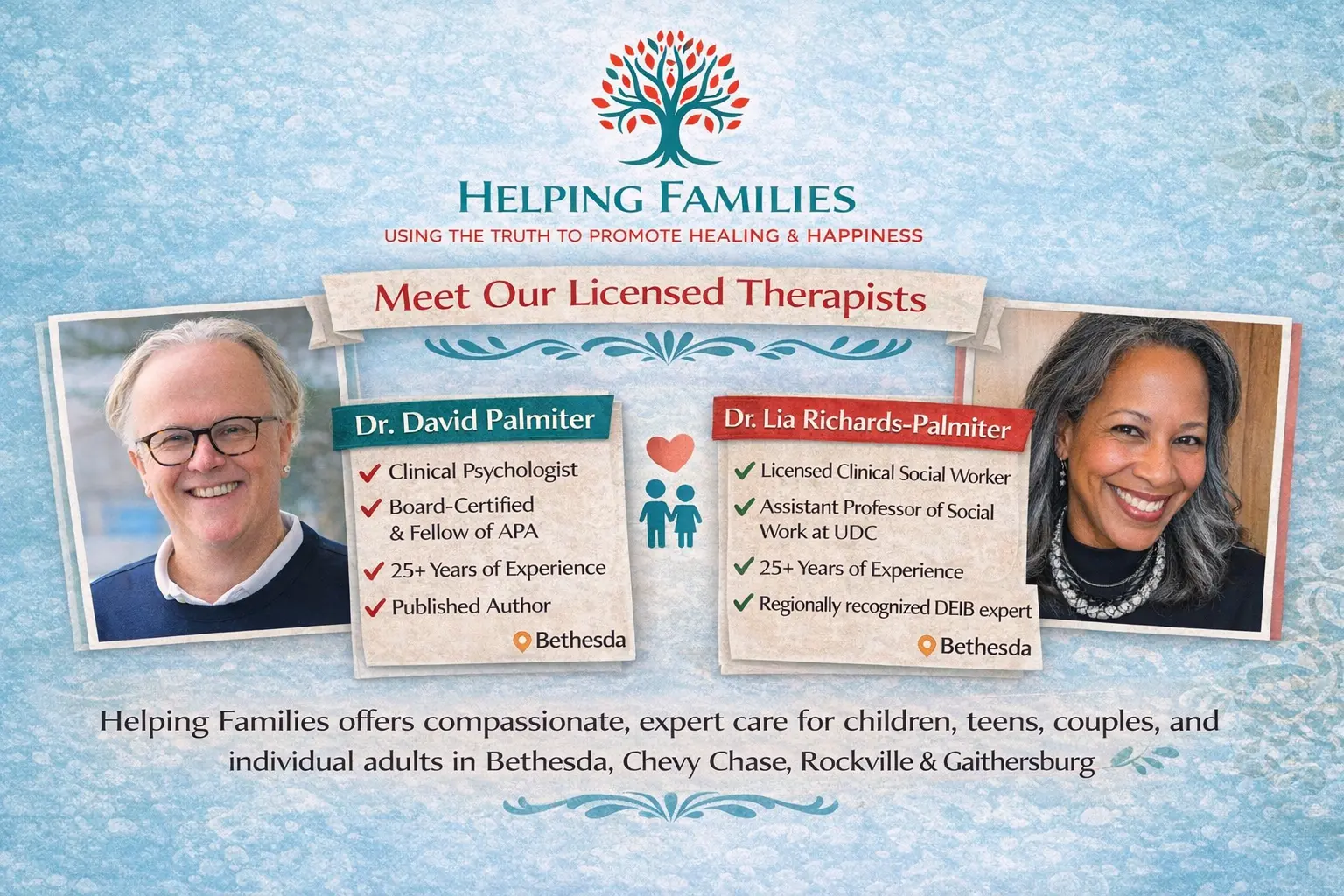
At Helping Families in Bethesda, MD, psychotherapy can support families, children, adolescents, couples, and individuals who want to build healthier relationships and a more emotionally safe home environment. In many cases, forgiveness is not the sole challenge, but it becomes a vital part of healing once the deeper patterns are understood and addressed.
Final Thoughts
Forgiveness in family life is essential because no family gets through the years without causing and experiencing hurt. The question is not whether harm will happen. The question is what the family will do next. Will pain be buried, denied, or stored as evidence for future conflict? Or will the family learn how to name hurt honestly, seek repair, make room for accountability, and gradually let go of what keeps love from moving forward?
Forgiveness does not mean forgetting, excusing, or accepting unhealthy behavior. It means choosing healing over bitterness, repair over emotional distance, and growth over permanent resentment. It helps children feel safe enough to learn from mistakes. It helps couples remain connected through difficult seasons. It helps families stay emotionally alive instead of emotionally guarded.
If your family feels stuck in resentment, repeated conflict, or old hurts that never seem to heal, support can help. At Helping Families, individuals, children, adolescents, couples, and families can find a safe and caring space to explore wounds, rebuild connection, and move toward healthier ways of living together. In the long run, forgiveness is not just about letting go of the past. It is about protecting the future of connections within the family.