To Use the Truth to Promote Healing and
Happiness

The Purpose of Psychotherapy

How Parenthood Can Hurt Your Marriage and How to Protect It

Discover how parenthood can strain a relationship and learn practical ways to protect your marriage, stay connected, and work as a team.

Most couples expect parenthood to change their lives. Fewer are prepared for how deeply it can change their relationship. Before children, many partners have more time to talk, rest, connect, recover from conflict, and notice each other as adults, not just as teammates handling logistics. After children, the rhythm usually changes immediately. Sleep cycles around the infant’s needs to be attended to. Conversations become shorter and are organized around distribution of labor. The relationship that once felt natural continues, over the years, to be crowded out by overwhelmed schedules, taking kids about, school meetings, homework, bedtime routines, financial pressure, and the relentless demands of caring for a family. We regularly tell adults who are considering having a child: there’s no way you can appreciate (1) how deeply you’ll love your child, as it’s more profound than any other kind of love, (2) how demanding it will be, and (3) how fatigued you’ll become.

That shift does not mean a marriage is failing. It means the relationship is entering one of the most demanding phases of adult life, especially if both parents work. Many loving couples feel more irritated, less connected, less patient, and less emotionally available after becoming parents. They may still care deeply about each other but feel like they are in a taxing business relationship rather than a rewarding and intimate marriage. That is why so many couples begin searching for ways to protect your marriage after parenthood. They are not trying to realize some ideal. They want practical ways to stay close, work as a team, and avoid separation and divorce.

For the families we serve in Bethesda, Chevy Chase, Rockville, and Gaithersburg, MD, this concern is common and important. At Helping Families, couples often need space to talk honestly about the pressure parenthood places on a relationship. They love their children deeply but, if not proactive, can readily find that their marriage is devolving and creating feelings of loss, resentment, loneliness, exhaustion, or alienation. They can see themselves as standing on opposite sides of a wide chasm and wondering how they got there. Those feelings are more common than many couples realize. What matters is not seeing the strain as inevitable. What matters is understanding how parenthood affects the relationship and taking intentional steps to protect it.

This article explores how parenthood can strain a marriage, why the pressure can build so quietly, and what couples can do to reconnect before distance turns into separation or divorce.

Why Parenthood Changes a Marriage So Much

Parenthood suddenly changes nearly every part of adult life. It affects sleep, routine, freedom, money, intimacy, identity, career decisions, stress tolerance, and the freedom to merely unplug and rejuvenate. It also stresses any pre-existing vulnerabilities such as depression, anxiety, substance use, or fidelity. We’ve seen cases of people looking to relieve themselves of a vulnerability by creating another being to love deeply. However, that often backfires; plus, relationships are terrible medicine.

Many partners are surprised by how quickly the relationship can devolve into talking only about current events and division of labor. Instead of sharing existential thoughts, important hopes, or vulnerable feelings, conversations become centered on logistics. Who is picking up the kids? Did anyone sign the form? Who is handling dinner? Did the pediatrician call back? Are we out of groceries? Of course, this sort of communication is necessary, but when it becomes the only kind of communication the distance between two people can grow.

Parenthood also exposes differences in temperament and expectations. One partner may want more structure, while the other is more flexible. One may feel constantly overwhelmed and under-supported, while the other feels criticized no matter how much they do. One may crave closeness after a hard day, while the other wants silence and recovery. One may want sex while the other feels too weary and unattractive to even consider that. Such temperamental differences are usually not new, but parenting magnifies and grows the stress they cause.

How Couples Slowly Lose Each Other

Most marriages are not damaged by one dramatic moment after children arrive. More often, the relationship erodes slowly. Here’s a super common problem: the time that’s invested in the marriage is the time that’s left over after life’s obligations have been met. As that leftover time is as mythical as a unicorn—what we call unicorn time—the relationship wilts from lack of attention. A couple becomes tired. Then reactive. Then short with each other. Then emotionally guarded. This can then lead to mistrusting each other’s motivation and intention or even the viability of the marriage. They stop checking in because it feels like there is no time or like the risk of an argument is high. Small hurts go unresolved, and become buried alive, because the family has some immediate need. The couple assumes they will reconnect later: after the baby sleeps better, after the school year settles down, after work gets less intense. But unicorn time is very rare and even mythical in some marriages.

This is one reason couples often say they feel like roommates. They are still functioning together. Bills are getting paid. Children are being cared for. The house is running. But underneath that functioning, the relationship feels underfed. There may be affection, but not much intimacy. There may be cooperation, but not much warmth. There may be loyalty, but not much joy. It’s this context that creates fertile soil for emotional or physical infidelity.

When couples do not make room for the relationship itself, resentment can quietly take over, especially if the buried-alive pain has accumulated. One partner may feel invisible. Another may feel like nothing they do is enough. One may resent always being the one to initiate sex, plan dates, plan vacations, or handle a dozen other things. One may believe they carry the mental load alone. Another may feel shut out or constantly corrected. Over time, even small patterns can begin to feel emotionally expensive. Also, keep in mind that counting (for example, “I do x, y, and z but you only do g and f”) is a symptom.

Common Ways Parenthood Strains a Marriage

Every couple experiences parenthood differently, but some pressures show up again and again. The first is exhaustion. Sleep deprivation reduces patience, emotional regulation, and the ability to recover from conflict. It becomes much harder to give grace when both people are already running on empty.

The second is uneven labor, or at least the feeling of it. In many marriages, conflict is less about whether both partners are working hard and more about whether both feel seen, supported, and understood. One partner may be carrying more of the mental load, anticipating needs, planning, and remembering everything. The other may be contributing significantly, but in ways that feel less visible. Without honest conversation, both people can end up feeling unappreciated.

Another strain is reduced intimacy. This can mean sex, but it also includes affection, humor, companionship, and sharing vulnerabilities. Parenthood can reduce libido, cause regular feelings of exhaustion, and make a couple feel like they’ve lost their closeness. If intimacy is not talked about with care, partners may start to interpret distance as an indication that they have chosen the wrong mate.

Parenthood can also create value conflicts. Couples may disagree about discipline, routines, screen time, spending money, schedules, education, family boundaries, or what children need emotionally. Those disagreements can feel more intense because they are tied to identity. Parenting often activates deeply held beliefs that originated from childhood experiences, sometimes without even realizing it.

Why Love Alone Is Not Enough

Many couples assume that because they love each other, the relationship will automatically bounce back. Love matters, but love alone does not protect a marriage from rupture. A relationship needs investment, not just good intentions. The difficulty is that parenthood creates the illusion that a couple can only invest in their marriage during unicorn time.

Couples are often kind to the marriage in theory but not in practice. They may say the relationship matters yet give it only scraps of time and energy. By the end of the day, there is nothing left to offer except fatigue. That is understandable, but it is also risky over time. The marriage does not usually collapse because a couple stopped caring. It suffers because caring was never translated into ongoing relational habits.

This is why couples who want to protect your marriage after parenthood need more than vague promises to do better. They need concrete ways to reconnect inside real life, not just during ideal seasons.

How to Protect Your Marriage After Parenthood

The good news is that protecting a marriage after children does not require grand gestures. It usually requires consistent, smaller choices that restore emotional connection and reduce chronic resentment. Couples do better when they stop waiting for life to calm down and begin building connection into the life they have now.

One of the most important shifts is treating the relationship as something that needs active care. That means checking in even when there is no crisis. It means noticing disconnection before it deepens into contempt or chronic loneliness. It means asking not only, “How are the kids?” but also, “How are you?”

It can help to focus on a few core practices:

  • Share your vulnerable thoughts and feelings with each other on a continuous basis. The path to a titanium bond travels through successful and shared experiences of vulnerability.
  • Discuss dividing responsibilities in a manner that feels open, fair, and flexible. The same thing goes with how you save and spend money, and on what.
  • Schedule a weekly date, which could be at any hour. For example, before the kids get up, because if kids are there it ain’t a date. Consider this aphorism: “a date night a week makes divorce obsolete.”
  • Repair conflict sooner, before distance grows. Don’t open with your position about the conflict or your take on your partner’s failings with the problem. Instead, open with acknowledging your contribution to the conflict and anything positive about your partner’s approach to the problem.
  • Do weekly acts of kindness for your partner that aren’t a part of your normal routines. Do this without counting and without expectation of a response or return. You’re doing this because it grows you as a person, not because you’re trying to engender reciprocity or gratitude in your partner.
  • Have an open and flexible discussion about your sex life, trying to mix it up in ways that you both are comfortable with. Remember, anything done in the same manner over and over again can become as engaging as flossing teeth.

These are a few simple ideas, but they matter because marriages are sustained through consistent acts of loving kindness. For deeper and more robust strategies, you might consider the possible value of couple’s counseling or marriage counseling.

Make Room for Real Check-Ins

Many couples communicate constantly after children, but very little of it is relational. They are coordinating, reminding, solving, and managing. Real check-ins are different. They create space to ask, “How have you been feeling lately?” “Where are you feeling stretched thin?” “What has felt hard between us?” “What would help you feel more supported?”

These conversations do not need to be long or dramatic. In fact, they are often more effective when they are regular and simple. A ten-minute check-in a few times a week can do more for a marriage than waiting until both partners are already upset. The goal is not to force heavy emotional processing all the time. The goal is to remain emotionally aware of each other. If you really want to lean into this, you could consider writing a gratitude letter (GL). A GL is about 300 handwritten words expressing only gratitude for your partner. You then read it to them, in person, and give it as a gift when finished. Many find this feels like injecting joy juice into each person’s veins.

When couples stop checking in, they start guessing. One partner assumes the other is fine. The other assumes their stress is obvious. Misunderstanding grows in the silence. Buried-alive pain—which often leads to verbal explosions or harmful behaviors when it accumulates—also grows in silence. Small check-ins tend to interrupt that pattern.

Do Not Let Resentment Do the Talking

As marriages devolve, resentments can grow to the point that they start feeling like another member of the family. It speaks through sarcasm, withdrawal, scorekeeping, criticism, infidelity, substance abuse, and the ongoing feeling that one person cares more, carries more, or sacrifices more. Resentment is often a signal that something important has not been addressed effectively.

Sometimes the answer is practical. A couple needs a more realistic division of labor. Sometimes the answer is emotional. One partner does not feel appreciated or prioritized. Sometimes both or other things are true. What rarely helps is letting resentment leak out sideways through sharp comments, repeated negative assumptions, and toxic behaviors.

It is healthier to name the issue directly and early. Saying things like, “I miss you and would like to become closer again,” or “It would help me to be more upbeat if we could get on the same page about our expenses,” is far more useful than letting frustration build until speed bumps cause crashes. Protecting a marriage after parenthood often depends on catching resentment before it has metastasized.

Rebuild Intimacy in Smaller Ways First

Couples often think of intimacy as equating with mutually enjoyable sex, but it helps to think of it more broadly. Intimacy certainly includes physical affection, but it also includes kindness, attention, humor, emotional openness, and feeling emotionally safe with each other. If the relationship has become tense or distant, trying to fix that by creating pressure to have sex will not usually work well. It is often more effective to rebuild the less complicated forms of closeness first.

That may mean sitting together at the end of the day instead of in separate rooms. It may mean reaching for each other physically in ordinary moments. It may mean texting something warm during the day that is not about a task. It may mean returning to small rituals that remind both partners they are more than co-managers of the household.

When couples feel emotionally connected, sex usually feels less complicated. When emotional distance is high, everything can feel like one more burden. Rebuilding warmth often starts with loving kindness, gentleness, and attention.

Work as a Team, Not Opponents

Parenthood can make couples feel like they are on opposite sides of the same problem. One feels unsupported. The other feels criticized. One feels overburdened. The other feels dismissed. When that pattern sets in, both partners start protecting themselves instead of protecting the relationship.

A better frame is to keep asking, “How do we solve this as a team?” That language matters. It changes the emotional posture of the conversation. Instead of proving who is right or who is working harder, the couple begins looking at the family system together. What is not working? What needs to be adjusted? What expectations are unrealistic right now? Where do we need more help?

Sometimes protecting the marriage means lowering the bar in other places. The house may not need to be perfect. Every obligation may not need to be accepted. Some seasons require couples to simplify, outsource, say no more often, or stop comparing themselves to families who look more put together from the outside.

Do Not Ignore the Couple Relationship

Many loving parents become so child-focused that the marriage becomes invisible except when there is conflict. Of course, children need care, attention, and responsiveness. But a healthy family is not built only on parent-child bonds. It is also built on the quality of the adult relationship guiding the home. Airline attendants give great advice about oxygen masks when travelling with a child.

Children generally benefit when they grow up in a home where the adults show respect, repair conflict, and remain connected. That does not mean children should come second in a simplistic way. It means the marriage should not disappear entirely under the banner of good parenting. In the long run, protecting the couple relationship is often part of protecting the family itself. Moreover, the nature of the parents’ marriage deeply affects what kids expect a marriage to be, or not be, as an adult.

Couples who want to protect your marriage after parenthood do well to remember that the relationship is not a luxury project to return to later. It is part of the emotional structure of the family.

When It Is Time to Seek Couples Therapy

Sometimes couples know what they should do but feel unable to do it consistently on their own. The same arguments repeat. One partner shuts down. The other escalates. Old resentments keep resurfacing. Conversations about parenting, intimacy, time, in-laws, or support quickly turn defensive. In those moments, couples counseling can help not because the marriage is broken beyond repair, but because the couple needs a different set of maintenance strategies to prosper.

Marriage counseling can provide a safe, guided space to slow down reactive patterns, clarify unmet needs, and strengthen communication. It can help partners see how each person is contributing to the cycle without turning the process into blame. It can also help couples reconnect around the shared values that often get buried under exhaustion and stress.

For couples living in Bethesda, Chevy Chase, Rockville, or Gaithersburg, MD, reaching out for help can be a practical act of care, not a sign of failure. At Helping Families, couples therapy can support partners who want to reconnect, work through parenting-related strain, and rebuild their closeness.

Final Thoughts

Parenthood can bring joy, meaning, and love into a family, but it can also strain a marriage in very real ways. Exhaustion, unequal distribution of labor, less intimacy, unresolved resentment, and the nonstop demands of caregiving can slowly weaken the bond between partners if the relationship is left unattended. That does not mean your marriage is destined to be dysfunctional after children. It means your marriage needs intentional and continuous care during one of life’s most demanding seasons.

If you want to protect your marriage after parenthood, start by accepting that the relationship deserves attention now, not only later when life feels easier. Small check-ins matter. Sharing vulnerabilities and fun matters. Loving kindness matters. Getting on the same page about finances, labor, and sex matters. Rebuilding trust matters. Asking for help matters.

You do not need a perfect marriage to create a healthy family. And all marriages suffer periods of distance. But you do need a relationship that is valued, nourished, and not reliant exclusively on unicorn time. If you and your partner feel more distant than you want to feel, or if parenthood has pulled you into cycles of stress and disconnection, couples therapy can help you slow down, reconnect, and move forward more intentionally.

At Helping Families in Bethesda, MD, couples can find a safe and caring space to explore relationship stress and to learn science-based, time-efficient, and effective relationship mechanics for promoting a thriving marriage. Parenthood changes a marriage, but with insight, effort, and support, it does not have to slay it.

Our Approach

Helping Families is a psychotherapy practice dedicated to providing a safe and caring space for individuals, children, adolescents, families and couples to explore, heal and self-actualize. Our practice is built on over 50 years of experience offering specialized and science-based mental health care tailored to the unique needs of each person and family. We are committed to helping families and individuals break free from emotional distress and lead enriching lives. Our approach is rooted in empathy, understanding, DEIB awareness, and evidence-based techniques to support transformative change.

ADHD

ADHD is a highly misunderstood neurodiversity. Our approach is to use evidence-based methods for diagnosing, treating and actualizing the unique potential of every person who either has ADHD or who lives with a loved one with ADHD.

Anxiety

Anxiety can be overwhelming, but a science-based treatment can often keep it from interfering with the quality of a person’s life. Our therapy sessions provide a safe environment for individuals to explore the root causes of anxiety and to develop coping strategies for living a calmer, more balanced life.

Depression

Depression can feel crushing and isolating, but you or your child can often find significant relief. Our science-based and tailored approach to treating mood disorders offers people a collection of practical tools to regain hope, find purpose, and develop the skills to navigate through life's challenges with resilience.

Disruptive Behavior

Nothing gets a kid referred faster for mental health care than annoying an adult. Oppositional Defiant Disorder and Conduct Disorder can dramatically unsettle a classroom and a home life, making it a top stress for all involved. We use science-based treatments to eliminate ODD, in a child 12 years or younger, in the large majority of instances, in 8 or less sessions. The transformation can be so quick and dramatic that many parents have asked us things like, "why isn't this information taught on maternity units in hospitals?!"

DEIB

Experiences of isms–racism, sexism, ageism, religionism, heterosexism and others–are ubiquitous in our culture, as are more subtle micro aggressions and systemic bias towards power down groups. In our practice we keep these issues in focus when a client has been hurt by them and help each person to grow in their advocacy skills while making tactical decisions about how they wish to proceed.

Happiness

Just about all of our clients present with a primary and acute concern (e.g., ADHD, mood, anxiety). However, our clients have greater ambitions than only to stop feeling badly. They want more and deeper experiences of meaning and joy. This is where the science of positive psychology comes into play. We routinely weave these interventions, of which we are very familiar, into the evidence-based structures that we offer.

Therapy for Youth

Childhood and adolescence can be a challenging time. Our therapies for kids and teens provide a supportive space to navigate complex emotions, build self-esteem, manage challenging family and school dynamics, and develop healthy coping mechanisms for a brighter future, both individually and within the family.

Couples Therapy

Couples therapy provides a safe space for partners to explore challenges, enhance communication, and rebuild trust. Our goal is to help couples deepen their understanding of each other and create a more fulfilling and harmonious relationship that is well equipped to solve problems and to have difficult conversations.

Adult Therapy

One of our favorite things to do is to work with adults who are sick-and-tired of being sick-and-tired. As Thoreau put it, many adults lead “…lives of silent and go to the grave with the song still in them.” We have a long track record of helping adults to use their top strengths, and the evidence-based skills we teach, to access the lavish banquet that surrounds us all and to live lives lavish with meaning and rich with purpose.

A Path to Healing and Happiness Starts Here.

Psychotherapy is a place to deeply reflect on how life is going. We are all so busy and overscheduled that creating this kind of space can be transformative. We are expert at using the truth of our clients’ lives to create understanding, to alleviate suffering, and to expand on experiences of meaning and joy.

Book Your First Free Consultation

Talk with a trusted therapist and take the next step forward with confidence.

Got Questions? We Have Answers!

We work with kids, teens and adults, starting at age 4.

We have the most experience with ADHD, Oppositional Defiant Disorder, Generalized Anxiety Disorder, Post-Traumatic Stress Disorder, OCD, Depression, Autism and helping kids overcome experiences of bullying, racism and microaggressions. However, we also have experience treating less common conditions such as Juvenile Onset Bipolar Disorder and Reactive Attachment Disorder.

This is a strength of our practice. When he was President of the Pennsylvania Psychological Association, Dr. Dave co-chaired a collaboration between the state’s child psychologists and pediatricians. The principal goal of this work was to develop a standard of care for outpatient mental health evaluations of youth. We use this protocol in our practice. It includes the following elements:

• A 90-minute interview with the child/teen of concern and their parents (in instances when there are two households, we collaborate on which adults to include).

• A 50-minute interview with the child/teen. For kids this often includes observations of drawing and play.

• The completion of a battery of parent, teacher and child/teen rating scales.

• Review of academic records

• Review of relevant clinical or forensic records

• The creation of a slide show that includes the following elements: sources of information, strengths, charts of behavior rating scales, a list of problems, a diagnostic impression and a list of interventions for the identified problems.

In preparing for the feedback we typically invest 3-4 hours of our time.

There are three ways we’d like to address this question.

First, we find that our field is replete with clinicians who are less aligned with the available science than our practice; this is also a finding in psychotherapy outcome studies. For this comparison the contrast is stark. We do a thorough evaluation, explain our goals and methods at each juncture, set measurable treatment goals, and empower our clients to verify for themselves how the science supports what we have concluded and what we are recommending.

Most of the treatments we offer are also structured, focused on skill building and involve between session practice (exceptions are when clients could benefit from psychodynamic therapy or play therapy, which we also offer). While a non-science-based practice can feel nice it may not yield transformational change (sort of like a psychological massage) and may be harder to differentiate from what an intelligent, life-experienced and warm-hearted friend might offer at no cost.

Second, another evidence-based practice will look more similar than different to ours.
However, a few things we offer that are less common is the thoroughness of the initial evaluation, our focus on strengths, our inclusion of biofeedback to treat anxiety, anger and stress management, the use of magic to engage kids and teens, our common practice of going into schools to collaborate on helping our child/teen clients, and an acute focus on how to effectively identify and manage experiences of isms and micro aggressions when that is relevant to the care.

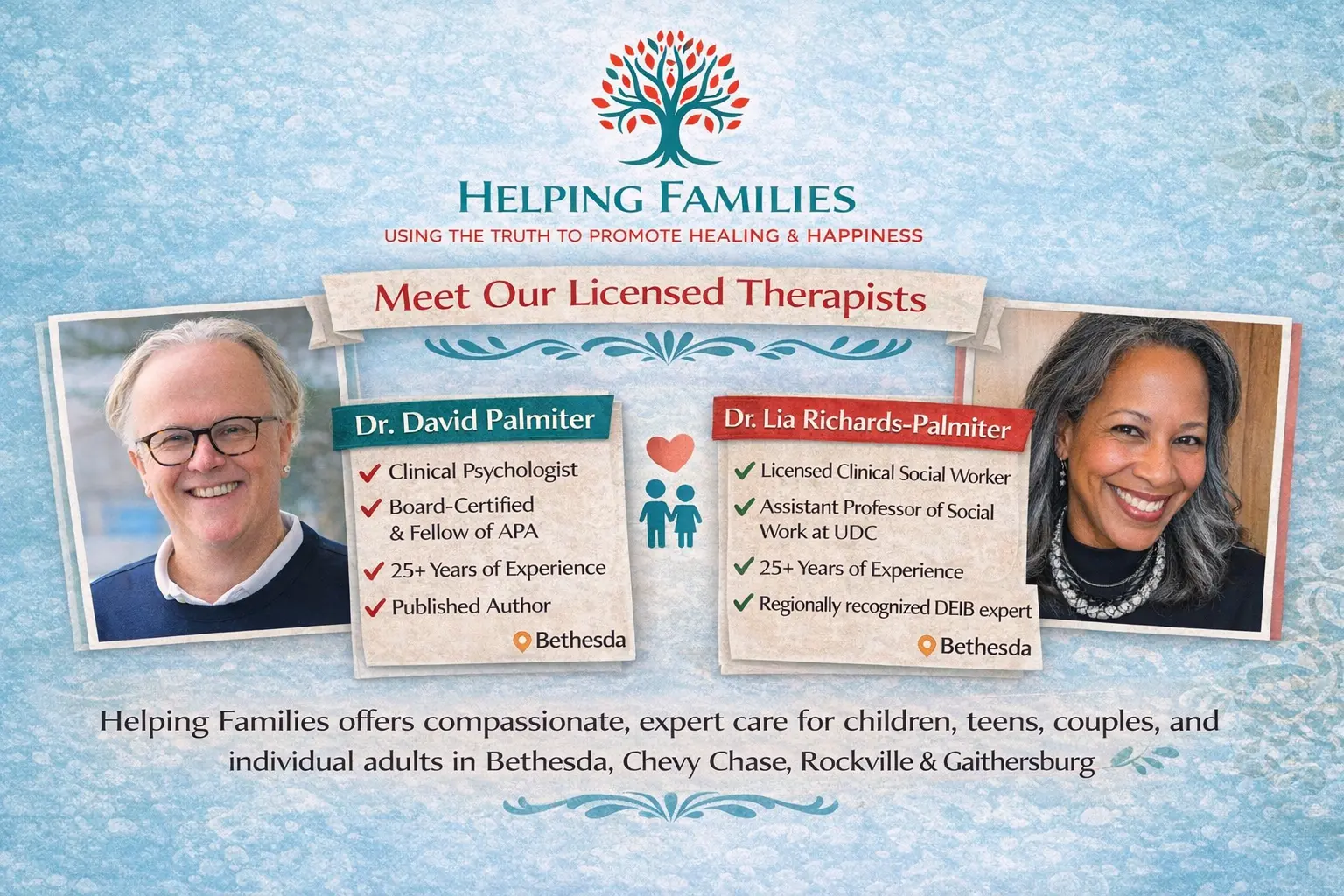
Third, we are highly experienced and credentialed clinicians, published authors, media consultants and leaders in our fields. Bios ( Dr. Dave's BIO ) - ( Dr. Lia's BIO )

Our approach can best be described as a blending of behavioral (e.g., Gottman Institute) and emotionally focused (e.g., EFT) methods. (Dr. Dave can be found on the Gottman Institute’s therapist directory which only includes those clinicians that have completed at least two levels of their training).

Our initial evaluation includes a 90-minute couple interview, the completion of the Gottman Institute’s battery for couples (at no additional charge), the completion of a battery supplemental measures, a 50-minute feedback session and the preparation of a slide show that includes sources of information, strengths, results of the rating scales, a list of problems and a list of recommended interventions. It is common for us to spend 3-4 hours preparing for the feedback session.

Our treatment approach involves skill building, is structured and usually time limited. We say “usually” as the work can take longer when there are significant resentments that need to be resolved. In our opinion, the skills we teach are ones that all couples would do well to know before formalizing a long-term commitment. They are also practices that promote resilience in a couple’s life.

Yes, we do. The evaluation consists of a 90-minute interview, the use of behavior rating scales, a review of relevant records, and a feedback session that incorporates a slideshow that includes sources of information, strengths, results of rating scales, a problem list, a diagnostic formulation and a list of recommended interventions. We usually spend about two hours preparing the feedback for a standard adult evaluation.

We also specialize in ADHD adult evaluations; these include the additional elements of collaterals filling out rating scales, a review of academic records and any other records that might be helpful (e.g., performance evaluations at work). (Dr. Dave is formerly the Clinical Director of a nationally recognized ADHD specialty clinic and currently serves on the national Board of Directors for CHADD.)

The areas in which we have the most experience are ADHD, anxiety disorders (including OCD and PTSD), mood disorders, self-esteem, self-compassion, existential crises and self-actualization. We also focus on identifying and overcoming the effects of isms and micro aggressions when that is relevant. (Dr. Lia is on the faculty of an HBCU and has offered countless training on DEI issues for schools, employers, corporations and non-profits)

There are four things we’d like to say in response to this question.

First, our services are based on $280/hour, which we find is a little bit under what clinicians at our level of experience and credentials tend to charge in the DMV.

Second, while we are out-of-network providers, we arrange for our clients–at no cost–to use the services of Reimbursify.com to submit our statements to health insurance companies for reimbursement.

Third, please consider our bios and/or CVs ( Dr. Dave's BIO ) - ( Dr. Lia's BIO ). It’s difficult to summarize them here as we have 50+ years of cumulative experiencing doing clinical work, serving as professors, holding leadership positions, publishing (i.e., books, chapters and articles) and being media consultants.

Fourth, when thinking about costs, consider the costs that can be associated with not getting needed mental health treatment. For example, the cost of a contested divorce in the DMV ranges between $15,000 and $30,000+ per person, suicide is the second leading cause of death among people aged 10-24, unresolved mental health challenges increase the odds of substance dependence, academic underachievement, school dropout, vocational underdevelopment, relationship dissatisfaction, compromised physical health and overall lower quality of life. Also, consider what it would be like to be free of that which is troubling you, your child or your partner the most.
Stronger Kids. Stronger Relationships.

Compassionate, evidence-based therapy for children, teens, and couples—supporting healing from trauma, anxiety, depression, and ADHD while building resilience, connection, and lasting change.

Helping Families

Compassionate, evidence-based psychotherapy for children, teens, individuals, and couples—supporting trauma recovery, anxiety, depression, ADHD, and healthier relationships.

Blog

Explore our blog for compassionate, evidence-based insights and practical guidance to support the emotional well-being and growth of individuals, children, couples, and families.